
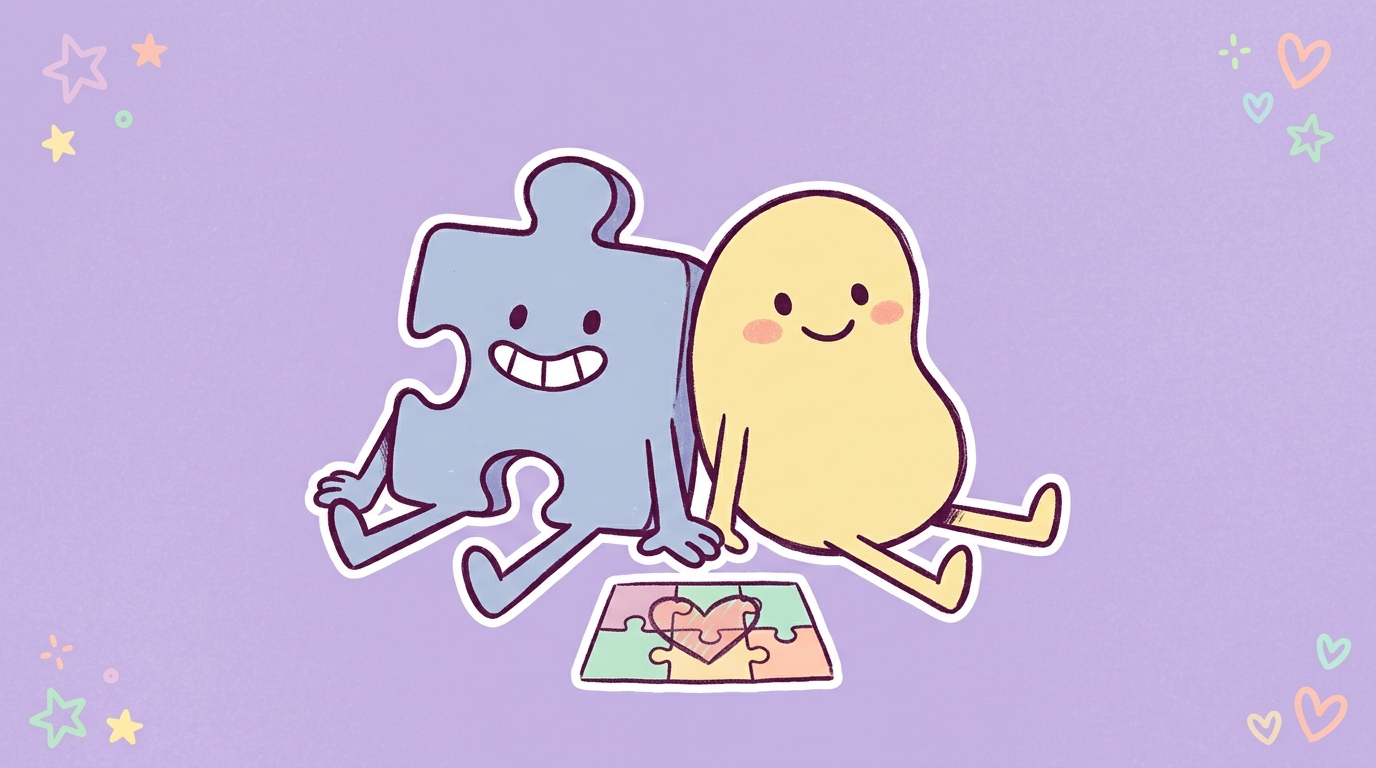
How Solving Puzzles Together Strengthens Relationships
In an era of parallel screen time and algorithmic isolation, the simple act of sitting together over a jigsaw puzzle or escape room challenge might seem quaint. Yet a growing body of research in neuroscience, relationship psychology, and behavioral science suggests that collaborative puzzle-solving activates some of the most powerful mechanisms we have for building and maintaining human connection. The benefits extend far beyond passing the time, reaching into the architecture of our brains, the chemistry of our hormones, and the long-term trajectory of our closest relationships.
Your Brain on Cooperation: Interpersonal Brain Synchrony
One of the most compelling recent discoveries in social neuroscience is interpersonal brain synchrony, the phenomenon where two people's neural activity begins to align when they cooperate effectively. A 2022 study published in Brain Sciences used functional near-infrared spectroscopy (fNIRS) to monitor pairs of participants as they solved jigsaw puzzles together. The researchers found that when pairs successfully completed a puzzle, their brains showed enhanced synchronization in three critical regions: Broca's area (involved in language processing and understanding others' actions), the frontopolar cortex (responsible for maintaining shared goals), and the right temporoparietal junction (which helps us infer what others are thinking and intending). [1]
What makes this finding particularly striking is what did not matter: whether the partners knew each other beforehand. Familiar pairs and strangers showed no significant differences in brain synchrony. Instead, it was the shared experience of successfully working through a challenge together that triggered neural alignment. This suggests that collaborative problem-solving itself, not pre-existing closeness, creates the conditions for deeper connection. In practical terms, puzzling together does not merely reflect a good relationship; it actively builds one.
The Chemistry of Shared Challenge
When two people collaborate on a puzzle, the neurochemical environment shifts in ways that promote bonding. Oxytocin, often called the "bonding hormone," plays a central role. A study by Ditzen and colleagues administered intranasal oxytocin to couples before a conflict discussion task and found that those receiving oxytocin exhibited significantly more positive communication behaviors (active listening, verbal affirmation, shared laughter) and lower cortisol levels compared to the placebo group. [2]
This matters for puzzle-solving because cooperative activities naturally stimulate oxytocin release. When partners work together, discussing which piece goes where, celebrating small victories, and navigating moments of frustration, they engage in precisely the kind of positive reciprocal behavior that triggers the oxytocin system. That oxytocin then makes them more attuned to each other's emotional states and more inclined toward further collaboration.
Longitudinal research by Schneiderman and colleagues found that new romantic partners showed significantly elevated oxytocin levels compared to singles, and critically, those initial oxytocin levels predicted which couples remained together six months later. [3] The implication is clear: regular shared activities that require cooperation may help sustain the neurochemical foundation of lasting connection.
Self-Expansion: Why Novelty Matters
Relationship psychologists Arthur and Elaine Aron developed the self-expansion model, which proposes that humans are fundamentally motivated to grow and expand their capabilities, and that romantic relationships thrive when partners facilitate each other's growth. Their research demonstrated that couples who regularly engage in novel and challenging activities together, precisely the kind of cognitive stretch that puzzles provide, report significantly higher relationship quality. [4]
The effect is remarkably efficient. In controlled experiments, even seven minutes of shared novel activity produced measurable increases in experienced relationship quality. Puzzles sit squarely within this framework. Each new puzzle presents a novel challenge with an uncertain outcome. The difficulty can be calibrated, ensuring the activity remains engaging without becoming overwhelming. Unlike watching a film or dining out, puzzles demand active cognitive participation from both partners, creating the conditions for self-expansion that the research identifies as critical for relationship maintenance. Try a daily word puzzle together and notice how quickly the conversation flows.
Entering Flow Together
When a puzzle's difficulty matches the solvers' combined skill level, something remarkable happens: participants enter a shared flow state. Psychologist Mihaly Csikszentmihalyi described flow as complete absorption in an intrinsically rewarding activity, a state associated with the highest levels of human happiness. Research by Brenda McDaniel at Kansas State University extended this concept into the relational domain, finding that couples who experience flow during shared activities are less likely to hold onto anger and stress, and more likely to report enduring relationship satisfaction. [5]
Puzzles naturally generate the conversations that create flow: the running commentary about patterns and strategies, the collaborative planning about where to focus next, the mutual encouragement through difficult sections. These interactions occur in a low-stakes context (no one's career or finances depend on completing the puzzle), which paradoxically makes them more emotionally authentic and connective than many higher-pressure shared experiences. A cooperative game like Chain It, where partners can work through word connections together, offers exactly this kind of calibrated challenge.
Beyond Couples: Families, Friends, and Communities
While much of the research focuses on romantic partnerships, the mechanisms apply broadly. Families who puzzle together create structured opportunities for intergenerational communication, where children practice turn-taking and negotiation while adults model patience and collaborative thinking. Friend groups who tackle escape rooms or cooperative board games activate the same brain synchrony and oxytocin pathways that strengthen romantic bonds.
The critical insight across all these contexts is that the puzzle serves as what psychologists call a "third thing," an external focus that alleviates the pressure of direct interpersonal engagement while simultaneously creating genuine opportunities for connection. For people with social anxiety, this indirect pathway to bonding can be transformative.
Putting the Pieces Together
The research paints a consistent picture: solving puzzles together strengthens relationships through a convergence of neurological, chemical, and psychological processes. Brain synchrony aligns partners' neural activity. Oxytocin deepens empathy and communication. Novelty triggers self-expansion and prevents relational stagnation. Flow states create peak shared experiences that buffer against everyday conflict. What distinguishes collaborative puzzling from other shared activities is its accessibility and scalability. It requires no athletic ability, no expensive equipment, no travel. It can last ten minutes or ten hours. And unlike competitive games, it positions all participants on the same side, working toward a shared goal with no losers.
Frequently Asked Questions
Does solving puzzles together actually strengthen a relationship?
Yes. Neuroscience research shows that cooperative puzzle-solving triggers interpersonal brain synchrony, oxytocin release, and shared flow states, all of which measurably increase relationship satisfaction and emotional attunement between partners.
What kind of puzzles are best for couples?
Any puzzle that requires active collaboration and can be calibrated to both partners' skill level works well. Jigsaw puzzles, cooperative word games, escape rooms, and daily puzzle apps all activate the same bonding mechanisms documented in the research.
How long do you need to puzzle together to see relationship benefits?
Research by Aron and colleagues found that even seven minutes of shared novel activity produced measurable gains in relationship quality. A follow-up intervention study found 90 minutes per week of exciting shared activity significantly boosted satisfaction after just four weeks.
References and Further Reading
- Pan et al. (2022). Interpersonal brain synchrony during cooperative jigsaw puzzle solving. Brain Sciences.
- Ditzen et al. (2009). Intranasal Oxytocin Increases Positive Communication and Reduces Cortisol During Couple Conflict. Biological Psychiatry.
- Schneiderman et al. (2012). Oxytocin during the initial stages of romantic attachment. Psychoneuroendocrinology.
- Aron et al. (2000). Couples' shared participation in novel and arousing activities and experienced relationship quality. Journal of Personality and Social Psychology.
- Bloom & Bloom (2019). Flow State Together. Psychology Today, citing McDaniel's research at Kansas State University.
Next Step
Ready to strengthen your relationships through puzzles? Try Chain It with a partner or explore all 13+ puzzle types on Puzzlit for your next shared challenge.
Also read: Are Word Puzzles a Form of Meditation? What the Science Says