
Logic Puzzles vs Word Puzzles: What Each One Actually Asks of Your Brain
"Which is harder, a logic puzzle or a word puzzle?" sounds answerable until you try. The honest reply is: harder for whom, and harder in what way. A retired English professor will breeze through a cryptic crossword that breaks an engineer in half. The same engineer can hold a Sudoku constraint network in mind while the professor stalls. Difficulty is not a property of the puzzle. It is a property of the meeting between a puzzle and a brain.
Two puzzles, two cognitive loads
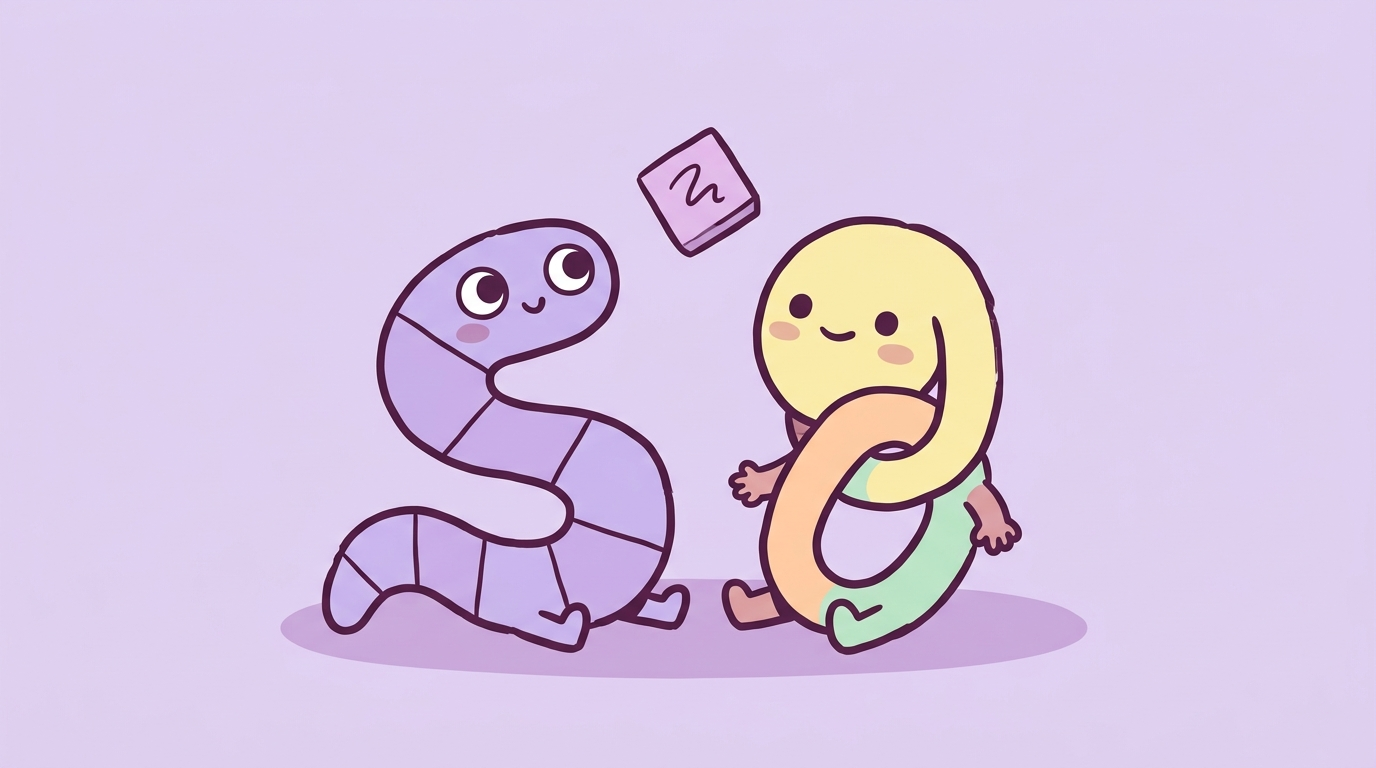
Consider two puzzles from Puzzlit. SnakeIt is a pure logic puzzle: a grid contains numbered tiles, and you connect 1, 2, 3, 4 and so on by drawing a single non-crossing path that fills the grid. ChainIt is a pure word puzzle. You complete a sequence where each blank starts with a given letter and must associate or compound with the word before it, like Club, House, Boat, Yard.
The two puzzles feel different, and that intuition is correct at the level of neural circuits. SnakeIt is a constraint-satisfaction and path-search problem. You simulate candidate routes, hold a partial path in working memory, detect dead ends, and backtrack. That is the cognitive package that lights up the dorsolateral and medial prefrontal cortex on neuroimaging. ChainIt is a semantic retrieval problem. You see "Club" and a blank starting with H, and your brain fans across associative memory for words that start with H and compound with "Club" (Source Reference: Patil et al., Translational Neuroscience).
What the brain does during a logic puzzle
A 2020 fNIRS experiment watched 28 participants' prefrontal cortex while they solved Sudoku, a close cousin of SnakeIt. Filling 3 by 3 subgrids recruited general prefrontal activity for scanning. Solving the full 9 by 9 grid added something distinctive: the medial PFC, particularly the frontopolar region, lit up significantly more. The authors call this the neural signature of heuristic rule selection, choosing which strategy to apply when simple scanning fails (Source Reference: Patil et al., Translational Neuroscience).
That is the demand SnakeIt places on a player. Easy boards yield to local scanning. Hard boards force you to select among strategies, including parity arguments, corner reasoning, or speculative path laying with mental backtrack. Logic puzzles are stress tests for the prefrontal cortex.
Spatial logic puzzles also transfer to other measures of visuospatial cognition. In 100 adults aged 50 and over, jigsaw-puzzle skill correlated with global visuospatial cognition at r = 0.80, recruiting at least eight abilities including mental rotation, constructional praxis, cognitive flexibility, and visuospatial working memory (Source Reference: Fissler et al., Frontiers in Aging Neuroscience).
What the brain does during a word puzzle
Word puzzles share the prefrontal demands of attention and self-monitoring but place their main load elsewhere, on the left-lateralized language network and on long-term semantic memory. This is why crossword skill correlates closely with crystallized intelligence, the accumulated store of facts, words, and meanings, while logic-puzzle skill correlates more with fluid intelligence, the capacity to reason about novel problems in real time.
The clinical evidence for word puzzles is unusually strong. In a 78-week randomized controlled trial run jointly at Columbia and Duke, 107 older adults with mild cognitive impairment were assigned either to crossword training or to a suite of computerized brain games. Crosswords won on the primary cognitive measure (ADAS-Cog) at both 12 and 78 weeks, won on a daily-functioning scale, and the crossword group showed less brain shrinkage on MRI at 78 weeks (Source Reference: Devanand et al., Columbia Psychiatry).
The longitudinal picture is consistent. In the PROTECT study of 19,078 adults aged 50 to 93, frequent word-puzzle solvers performed on grammatical reasoning at a level equivalent to being roughly ten years younger than peers who did not puzzle (Source Reference: Brooker et al., PROTECT). Earlier work shows regular crossword solvers experience accelerated memory decline about 2.54 years later than non-solvers, consistent with the cognitive reserve hypothesis (Source Reference: Pillai et al.).
So which is harder?
A logic puzzle is harder when working memory is the bottleneck. A word puzzle is harder when retrieval is the bottleneck, when the answer depends on a word or compound you either have stored or you do not. You cannot reason your way to "Yard" if "Boatyard" is not in your semantic network.
The right question is not which puzzle is harder but which mental muscle you are choosing to tax. Try one of each style on Puzzlit, and notice which one resists you.
Frequently Asked Questions
Are logic puzzles harder than word puzzles?
Neither category is universally harder. Logic puzzles tax working memory and strategic planning in the prefrontal cortex, while word puzzles tax the language network and stored semantic knowledge. Which feels harder depends on which system you have trained.
Which puzzle type is better for the aging brain?
Crossword training outperformed computerized brain games in a 78-week trial of older adults with mild cognitive impairment, and the crossword group showed less brain shrinkage on MRI. Word puzzles have the strongest clinical evidence for older adults, though logic puzzles still build fluid reasoning.
What brain regions do logic puzzles activate?
fNIRS imaging during Sudoku shows that the medial prefrontal cortex, especially the frontopolar region, activates strongly when players must select between strategies rather than scan locally. This is the heuristic rule-selection signature.
Do word puzzles really delay memory decline?
Frequent crossword solvers experience the onset of accelerated memory decline about 2.54 years later than non-solvers, and PROTECT cohort data link regular word puzzling to grammatical reasoning equivalent to being ten years younger.
References and Further Reading
- Patil et al., Role of prefrontal cortex during Sudoku task: fNIRS study, Translational Neuroscience (2020)
- Brooker et al., PROTECT cohort study, University of Exeter and King's College London (ScienceDaily, 2019)
- Devanand et al., Columbia and Duke COGIT-2 trial summary
- Fissler et al., Jigsaw Puzzling Taps Multiple Cognitive Abilities, Frontiers in Aging Neuroscience (2018)
- Pillai et al., Association of Crossword Puzzle Participation with Memory Decline
Train Both Halves of Your Puzzling Brain
Ready to find out which mental muscle needs the work? Play Chain It for word association retrieval, then explore all 13+ puzzle types on Puzzlit to stress your logic circuits next. Download the Puzzlit app to take both with you.
Also read: How Rebus Puzzles Enhance Memory: The Neuroscience Behind the Aha Moment