
What Makes a Crossword Puzzle Difficult
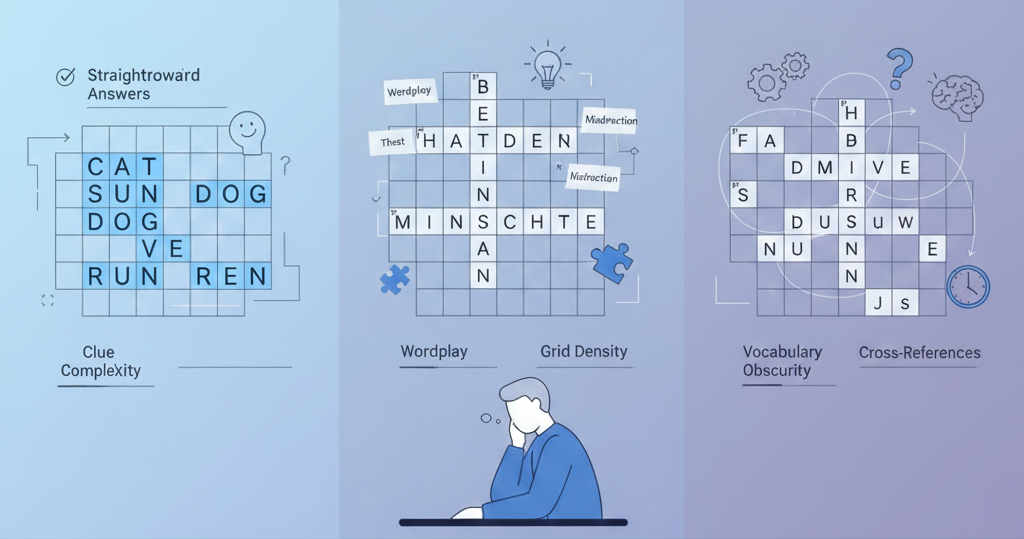
Every crossword solver has experienced it: one puzzle flies by in minutes, while another grinds progress to a halt. Difficulty in crosswords is not random, and it is not simply about how smart a solver is. Puzzle difficulty is the result of many deliberate design choices made by constructors and editors, combining language, logic, and psychology.
This article breaks down what actually makes a crossword puzzle difficult, moving beyond vague labels like easy or hard. Whether you are a casual solver, an aspiring constructor, or someone curious about how modern crossword apps evaluate difficulty, you will come away with a clear framework for understanding why some puzzles feel effortless and others feel almost impossible.
Clue difficulty versus answer difficulty
One of the most important distinctions in crossword design is the difference between clue difficulty and answer difficulty. A puzzle can use very common words but still feel challenging if the clues are indirect or rely on wordplay. Conversely, a puzzle can include obscure answers but clue them very straightforwardly.
Beginner-friendly puzzles tend to use direct definitions. Harder puzzles often rely on misdirection, where the surface meaning of the clue points you in the wrong direction. This gap between what a clue appears to say and what it actually means is one of the primary drivers of perceived difficulty.
The role of wordplay and misdirection
Wordplay is at the heart of crossword difficulty. When a clue asks for a synonym, the challenge is mostly vocabulary. When a clue involves puns, alternate meanings, or unconventional grammar, the challenge becomes interpretive.
Cryptic-style techniques sometimes appear even in standard crosswords: indicators that suggest a word should be altered, split, or reinterpreted. Solvers must learn to read clues with skepticism rather than taking them at face value.
Surface reading and false assumptions
A well-written clue reads like a natural sentence while secretly operating under a different logic. Hard puzzles are packed with these clues. They feel fair once solved, but not obvious beforehand. This balance between fairness and surprise is difficult to achieve and separates strong constructors from average ones.
Grid design and structural constraints
Difficulty is not only about clues. The grid itself plays a major role. A crossword with lots of short words and cross-checking letters is usually easier than one with long answers and fewer intersections.
The more letters each answer shares with others, the more chances a solver has to recover from uncertainty. Sparse grids reduce that safety net. Constructors use grid density strategically to control difficulty without changing a single clue.
Theme density and theme complexity
Many crosswords revolve around a theme. Easy puzzles often make the theme explicit early and repeat it clearly. Hard puzzles may hide the theme until late or apply it inconsistently. Some themes require solvers to mentally transform words before filling them into the grid.
Vocabulary: obscurity versus familiarity
Obscure words increase difficulty, but only up to a point. Most editors discourage excessive obscurity because it shifts a puzzle from challenging to frustrating. Instead, difficulty often comes from unexpected uses of familiar words.
For example, a common word used as a verb instead of a noun can trip up solvers. So can abbreviations, archaic meanings, or regional usage. According to Merriam-Webster, dictionary familiarity strongly influences how solvers perceive puzzle fairness.
Cross-referencing and dependency chains
Some puzzles include clues that depend on other answers. These cross-references can increase difficulty by creating dependency chains. If you cannot solve one entry, several others may remain blocked.
This technique raises the cognitive load on solvers and rewards patience. When done well, it creates satisfying breakthroughs. When overused, it can stall progress completely.
Solver expectations and experience level
Difficulty is relative. What feels brutal to a new solver may feel routine to someone who solves daily. Experienced solvers develop pattern recognition for clue types, common abbreviations, and constructor habits.
This is why many puzzle outlets scale difficulty across the week. Early-week puzzles emphasize accessibility, while late-week puzzles reward deeper familiarity with crossword language. The New York Times crossword famously follows this progression, a structure that many apps now emulate.
How modern apps measure and tune difficulty
Unlike print puzzles, digital platforms can measure how long puzzles take to solve, where solvers get stuck, and which clues generate errors. This data allows editors to fine-tune difficulty with precision.
Apps can also personalize difficulty, recommending puzzles based on prior performance. This is a major evolution from the one-size-fits-all newspaper model.
Where Puzzlit fits into crossword difficulty design
Puzzlit approaches difficulty as a spectrum rather than a fixed label. By offering multiple puzzle types and tracking performance over time, the app helps solvers gradually take on harder challenges without abrupt difficulty spikes.
Key factors that make a crossword puzzle difficult
- Indirect or misleading clue wording
- Complex or hidden themes
- Lower grid density and longer answers
- Unusual but valid word usage
- Cross-referencing between clues
- Solver experience and expectations
Test Your Skills
Want to see how your puzzle solving evolves over time? Try Chain It or Spell It, or explore all 13+ puzzle types to find your challenge level.
Also read: 7 techniques to solve any word puzzle faster