
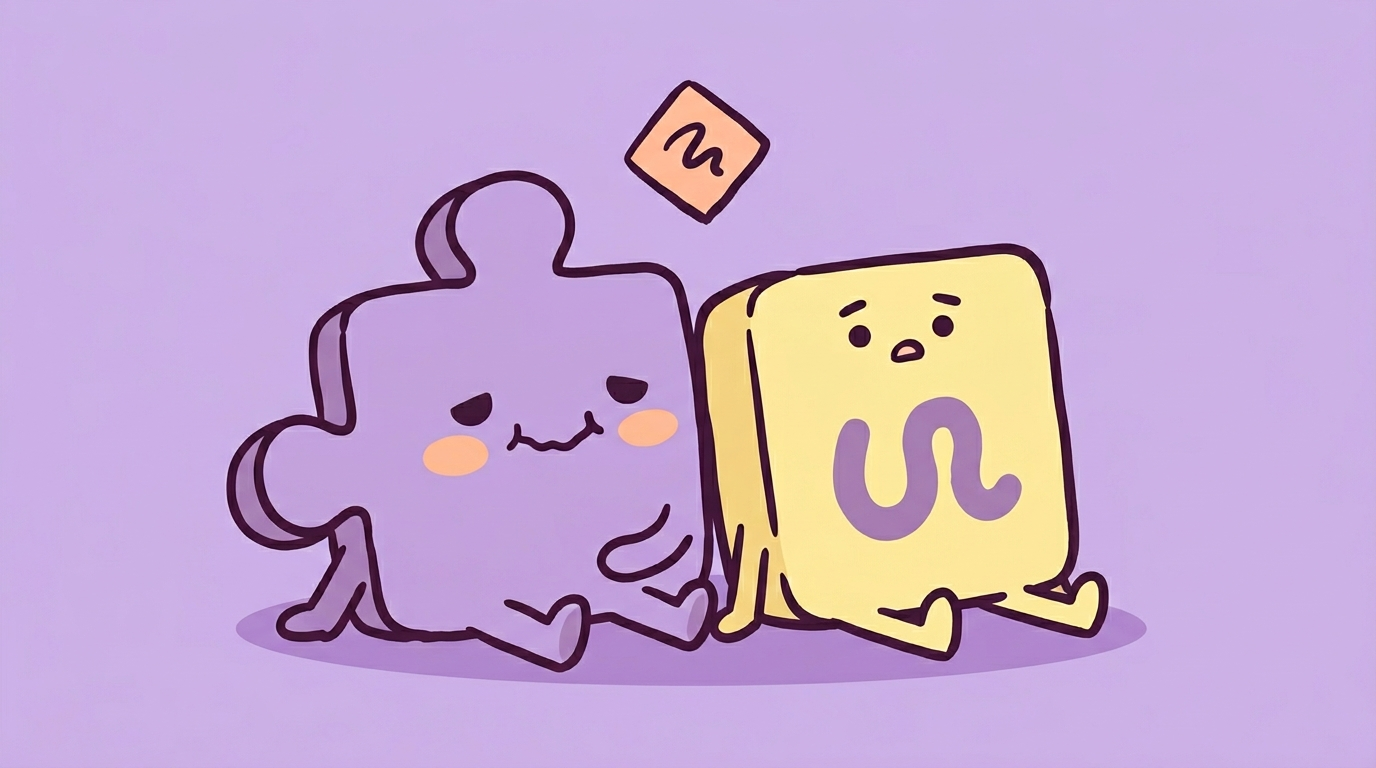
Why Some Puzzles Feel Impossible: The Brain Science of Being Stuck
Two people of similar intelligence can sit in front of the same puzzle and have completely different experiences. One slides into a focused groove and emerges twenty minutes later triumphant. The other stares for three minutes, feels a flush of frustration, and closes the tab. The puzzle did not change. Something in the relationship between puzzle and solver did. Understanding that gap is the most useful frame a designer can carry, and the most reassuring thing a struggling solver can learn.
The Flow Channel Is Narrower Than You Think
The cleanest model comes from Mihaly Csikszentmihalyi's flow theory. Flow is the state of complete absorption in a task just beyond reach but achievable, the diagonal corridor on a graph plotting challenge against skill [1]. Step above it and the brain registers anxiety; step below it and it registers boredom.
Difficulty, then, is not a property of the puzzle. It is a property of the interaction between the puzzle and the solver's current skill, vocabulary, and mood. A cryptic crossword clue that delights a Times regular is a wall to a newcomer with the identical IQ. When players say a puzzle is impossible, they are usually reporting that it has parked itself in their anxiety zone. Flow also requires immediate feedback and clear goals [1]. Many puzzles fail not because their difficulty is wrong but because they are silent, and silence reads as impossibility.
Cognitive Load: The Hidden Tax
John Sweller's cognitive load theory supplies the second piece [2]. It distinguishes intrinsic load, the unavoidable complexity of the problem itself, from extraneous load, the mental effort wasted on cluttered interfaces, ambiguous wording, and forced lookups. A third category, germane load, covers the effort spent building durable mental models [3].
A hard puzzle pushes intrinsic load to the edge of working memory on purpose. But extraneous load, a confusing rule or an interface that forces the solver to hold the grid in their head while scrolling, silently consumes the same scarce resource. Solvers experience the combined total as too hard and rarely diagnose which kind of load broke them [3]. The same puzzle, redesigned with clearer typography and a worked example, can move from impossible to satisfyingly hard without changing its logic.
The Aha Moment Is Doing Work in the Background
The third piece is neurological. Kounios and Beeman's EEG and fMRI work shows that insight, the aha, is not a thunderbolt from nowhere. It is the visible surface of unconscious processing that has been running for seconds or minutes, with right-hemisphere semantic activity preceding the conscious solution [4].
The implication is uncomfortable. The period right before a breakthrough looks identical, from the inside, to being stuck forever. A solver who quits at minute three may be one minute from the aha. Impossible is sometimes just not yet.
Designing Hard-but-Fair: A Real Example
How do working designers thread this needle? Consider ChainIt, a word puzzle where players complete a chain by filling in blanks. The top word guides the next, the first letter of each blank is revealed, and the connection must be a compound or associated word (think Club to House, Computer to Screen). There is exactly one acceptable answer per blank, and hints reveal the next letter on demand.
Per our internal ChainIt analytics, about 40 percent of users use a hint on a given puzzle. In a recent in-app survey, 20 percent reported that without the hint they would have left the game entirely. Both numbers map onto the theory. The 40 percent are players whose challenge-skill balance has drifted into anxiety, and the hint nudges them back into flow. The 20 percent are players for whom impossible would have meant abandoned, a one-in-five churn risk the hint system converts into completions. Crucially, the ChainIt hint is not the answer. It is a single letter, the smallest possible reduction in intrinsic load.
The Industry Evidence
A 2023 study modeling mobile puzzle completion with reinforcement-learning agents on Lily's Garden found the strongest predictor of human completion rate was the move count of the agent's top-5 percent runs, a direct proxy for intrinsic difficulty [5].
The dynamic-difficulty literature is more sobering. A 2024 study by Fisher and Kulshreshth compared five DDA approaches, including emotion-based adaptation driven by heart rate and galvanic skin response. Adaptive strategies produced measurable but inconsistent differences, with no approach clearly outperforming static or player-selected difficulty [6]. Tuning difficulty matters, but tuning the experience around difficulty, feedback, visible progress, and well-shaped hints, matters at least as much.
So What Makes a Puzzle Feel Impossible?
A puzzle feels impossible when one of four things has happened: the challenge overshot the solver's skill, the interface piled extraneous load on top of legitimate difficulty, the solver bailed during the silent pre-insight phase, or the game refused a graceful exit ramp back into flow. The good news is that impossible almost never means unsolvable. It usually means mis-calibrated, mis-presented, or mis-timed.
Frequently Asked Questions
Why does a puzzle feel impossible even when other people solve it easily?
Difficulty is not a fixed property of the puzzle. It is the interaction between the puzzle and your current skill, vocabulary, and mood. A puzzle that lands in another solver's flow channel can park itself in your anxiety zone, which the brain registers as impossibility.
What is the difference between a hard puzzle and an unfair one?
A hard puzzle has high intrinsic cognitive load by design. An unfair puzzle adds extraneous load through confusing interfaces, ambiguous wording, or missing feedback. Solvers feel both as too hard but only the second can be fixed without changing the puzzle's logic.
Should I use hints when stuck?
Yes, when the hint is a small nudge rather than the answer. A minimal hint, such as a single revealed letter, can restart unconscious processing without robbing you of the aha moment.
How long should I struggle before giving up?
Longer than feels comfortable. EEG studies show the pre-insight phase looks identical to being permanently stuck. Players who quit at three minutes often abandon a solution that was a minute away.
References and Further Reading
- Chou, Flow Theory Guide
- Sweller et al., Cognitive Load Theory (2011)
- Decision Lab, Cognitive Load Theory
- Kounios and Beeman, The Aha Moment (2009)
- Kristensen et al., Estimating player completion rate (2023)
- Fisher and Kulshreshth, Dynamic Difficulty Adjustment (2024)
Next Step
Ready to test a puzzle that was designed for the flow channel? Try Chain It or explore all 13+ puzzle types on Puzzlit.
Also read: What Makes a Crossword Puzzle Difficult